

How Fashion Brands Can Prepare for 2026-2029 Sustainability and Transparency Regulations


The 2026-2029 regulatory framework is shaping up to be pivotal for fashion brands all over the world. New regulations target fast fashion, environmental impact disclosure, supply chain transparency, and product traceability. Compliance is no longer a matter of good practice: it is a condition for market access, in the European Union, in national markets such as France, and in the United States.
For brands, the challenge is operational: how to translate legal obligations into actionable processes, IT systems, and team workflows.
The 2026–2029 Regulatory Wave: What's Coming
The obligations fall into two blocks: a harmonised EU framework built on product-level rules, and a patchwork of US state and federal requirements. They differ in structure and enforcement logic, but they land in the same window.
The EU Framework
These are among the main regulatory challenges facing fashion brands in the EU in 2026-2029.
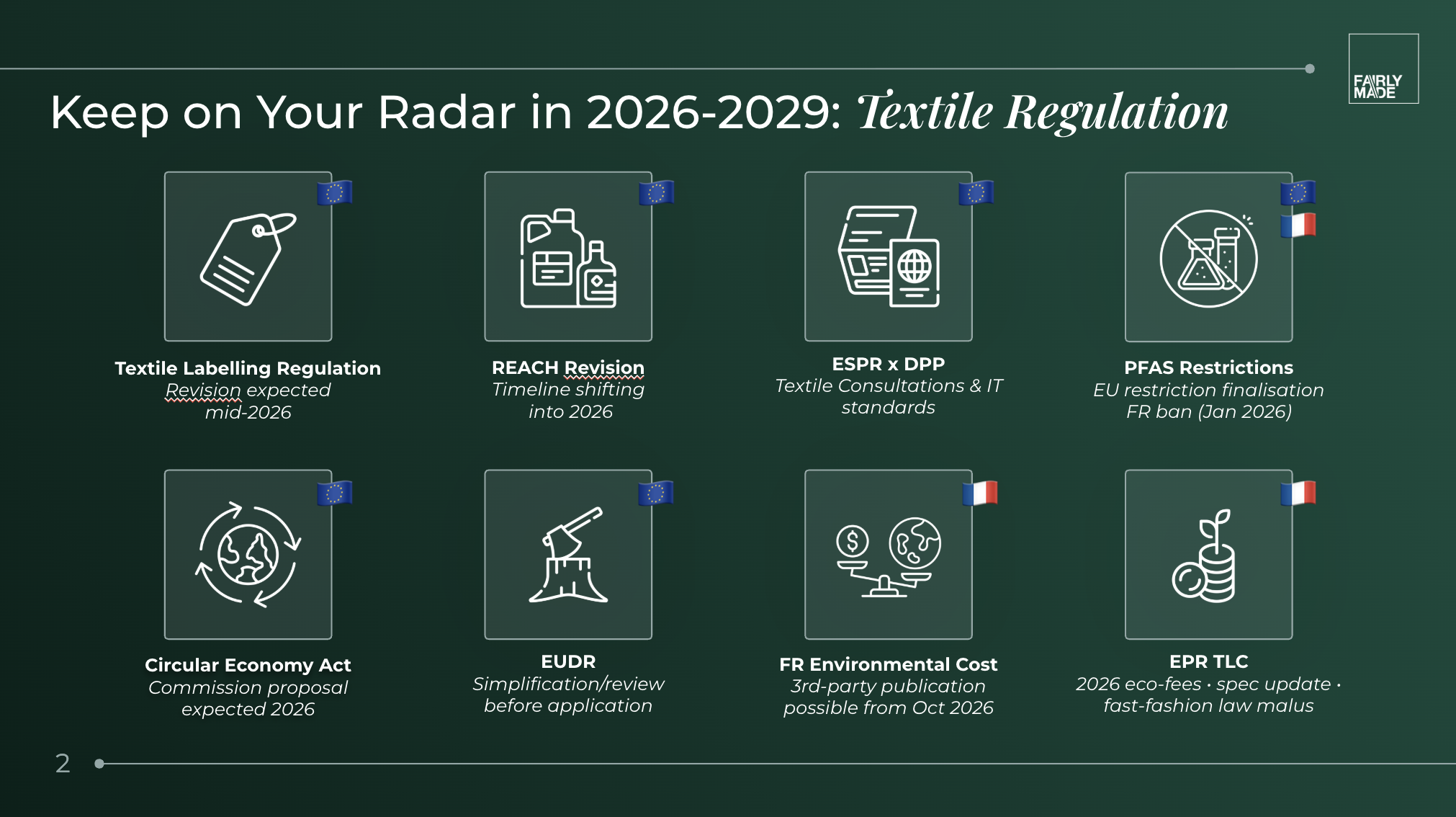
- ESPR and the Digital Product Passport. The framework regulation for future product requirements: durability, fibre composition, recyclability, substances of concern, plus a machine-readable record of composition, origin and environmental impact. Nothing binds textiles yet — requirements arrive through a delegated act indicated for 2027, followed by a minimum 18-month transition, so roughly 2028. The infrastructure is already live: the Commission opened the DPP Registry and testing environment on 20 July 2026. Context: EU Textiles Strategy; data points in our 2026 DPP guide.
- Textile EPR under the revised Waste Framework Directive. In force since 16 October 2025. Every Member State must set up an extended producer responsibility scheme for textiles and footwear, with producers paying a fee per product to finance collection, sorting, re-use and recycling. Fees are eco-modulated against durability and recyclability, including ESPR criteria, so ecodesign decisions feed straight into cost. Timing runs by transposition (20 months to transpose, 30 months to make schemes operational) putting live textile EPR across the EU in late 2027 to 2028. See the Commission announcement.
- EUDR. Covers cattle and therefore leather, which puts footwear, bags and leather goods in scope. Operators must show products are deforestation-free after 31 December 2020 and legally produced, backed by plot-level geolocation and a due diligence statement. The May 2026 simplification package confirmed no further delay: 30 December 2026 for large and medium-sized operators, 30 June 2027 for most micro and small ones. Downstream operators were relieved of full due diligence, but a brand importing finished leather goods is the operator, not a downstream actor. Commission update; our EUDR briefing.
France: Three Overlapping Layers
France remains the most advanced national market, and its structure shows how member-state law stacks on top of EU rules.
- AGEC (Law no. 2020-105 of 10 February 2020). The foundation. It prohibits the destruction of unsold textiles, assigns end-of-life responsibility through the Refashion EPR scheme, and requires consumer-facing disclosure on recycled content, microplastics, recyclability and country of manufacture for the main production stages. Full text: Légifrance; our breakdown of Article 13 obligations.
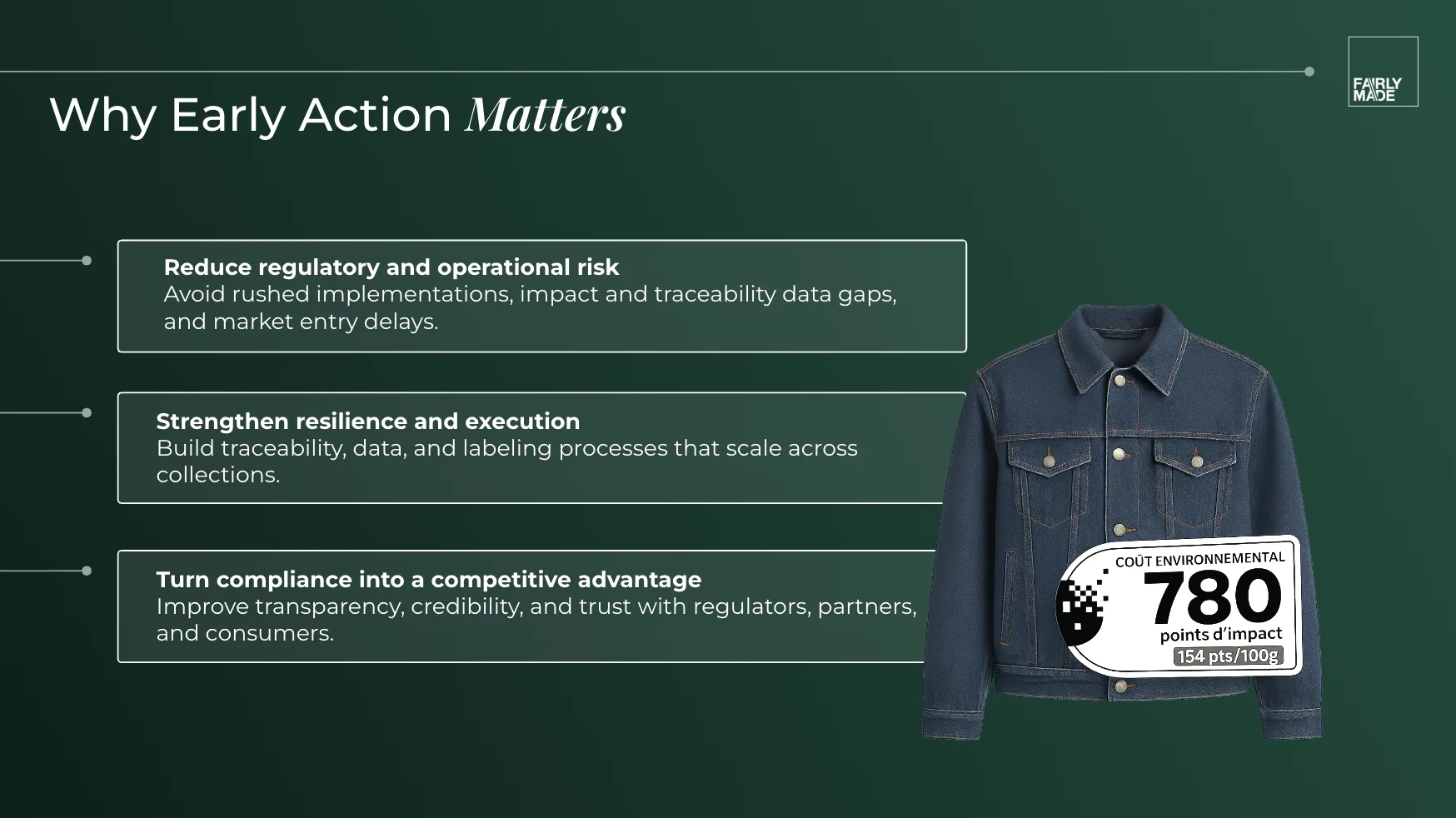
- Environmental Cost. Decree no. 2025-957 of 6 September 2025 and its accompanying order set the life cycle assessment basis and signage for the environmental cost of textile products, in force since 1 October 2025. Display is voluntary at EU request, but conditional: a brand communicating any other environmental score on a product must display the environmental cost alongside it, at least the same size, and publish the underlying data on the official state portal beforehand. From October 2026, third parties may calculate and publish a score where a brand has not. Consumer-facing summary: economie.gouv.fr; methodology in our 2025–2026 guide.
- Law no. 2026-602 of 8 July 2026 on the environmental impact of the textile industry. A penalty applies from 1 September 2026, modulated by range breadth, collection renewal frequency and repairability incentives, rising on a fixed trajectory to between €2 and €20 per product from 2030 and capped on request at 50% of the pre-tax sale price. Advertising for products in scope is prohibited from 1 January 2027, influencer promotion included. One provision reaches well beyond the platforms it targets: any producer subject to French textile EPR that is not established in France must appoint a France-based authorised representative. Ministry summary: ecologie.gouv.fr; qualifying thresholds in our analysis of the law.
Other member states are following the template: Italy's SNET ecoscore bill is the closest parallel.
The United States: State-Led, and Already in Force
There is no federal fashion law. Obligations come from individual states, with a few federal frameworks in the background, and several are enforceable now rather than pending.
- California SB 707 (Responsible Textile Recovery Act of 2024). The first US textile EPR programme. Producers of covered apparel and textile articles must form and join a producer responsibility organisation; CalRecycle was required to approve a PRO by 1 March 2026 and selected Landbell USA on 27 February 2026. Scope follows market access rather than physical presence, and companies below $1 million in annual aggregate global turnover and exclusively secondhand sellers are excluded. Implementing regulations come no earlier than July 2028, with administrative penalties of up to $10,000 per day and $50,000 per day for intentional or knowing violations. Programme page: CalRecycle — Textile Stewardship.
- California SB 253 (Climate Corporate Data Accountability Act). US-formed entities doing business in California with more than $1 billion in annual revenue must report Scope 1 and Scope 2 emissions in 2026, with Scope 3 from 2027. CARB approved the initial implementing regulation on 26 February 2026.
- The forced-labour import ban: Section 307 and the UFLPA. The one US framework that stops shipments at the border. Section 307 of the Tariff Act of 1930 (19 U.S.C. § 1307) prohibits importing goods mined, produced or manufactured wholly or in part with forced labour. The Uyghur Forced Labor Prevention Act sharpens it: for merchandise imported on or after 21 June 2022, CBP applies a rebuttable presumption that goods made wholly or in part in the Xinjiang Uyghur Autonomous Region, or produced by an entity on the UFLPA Entity List, are barred from entry. The presumption reaches goods manufactured in or shipped from any other country if any input originated in Xinjiang, and cotton is one of the high-priority sectors named in the statute, which puts much of apparel and home textiles in the frame. Rebutting it requires clear and convincing evidence that no forced labour was involved, meaning a documented, traceable supply chain down to raw material; otherwise CBP may detain, exclude, or seize and forfeit the shipment. DHS UFLPA FAQs.
A frequently cited item that does not belong on a compliance list: the New York Fashion Act remains a proposal in committee, not enacted law. Practical guidance on import-side exposure is in our US tariffs and forced labour brief.
From Framework to Obligation
Read together, these instruments converge on one operational requirement. ESPR wants product-level data. Textile EPR prices it. EUDR demands plot-level origin, and Section 307 proof of it at the border. France requires it displayed, California reported. The legal texts differ; the underlying asset is the same: verified, structured traceability data.
Which makes the practical question not what does the law say, but which of these applies to my brand, and what needs to be in place before it does.
1. Map Raw Materials at Risk and Implement Full Traceability
Three converging regulations are changing what brands are expected to know about their raw materials. The EU Deforestation Regulation (EUDR) requires proof that commodities such as leather, rubber and wood are deforestation-free, backed by geolocation data down to the plot of land. The Ecodesign for Sustainable Products Regulation (ESPR) will carry material-level data through the value chain via the Digital Product Passport. The French Environmental Cost scores products on data you can substantiate, and applies penalising defaults where origin is unknown. Different obligations, same prerequisite: knowing what your materials are and where they come from. That mapping exercise is the foundation everything else is built on.
Start by:
- Identifying materials at high risk.
- Engaging suppliers to provide precise origin data for all high-risk raw materials.
- Implementing traceability systems to track materials from source to finished product.
By building a full traceability framework, brands not only comply with regulations but also gain insights into supply chain vulnerabilities, enabling proactive risk management.
2. Structure Internal Product Data and Upgrade IT Systems
Many new regulations, including the Environmental Cost in France and the EU's Ecodesign for Sustainable Products Regulation with the Digital Product Passport, require brands to generate and manage extensive product data. This includes environmental impact metrics, lifecycle data, and compliance records for each item.
Key operational steps include:
- Standardizing product data fields across design, sourcing, and production systems and teams.
- Centralizing information in integrated IT systems (traceability platform, ERP, PLM) to support reporting, labeling, and regulatory submissions.
- Linking product data with sustainability metrics, supplier certificates, and digital product passports.
Structured product data ensures that teams can quickly respond to regulatory requests and avoid delays at market entry.
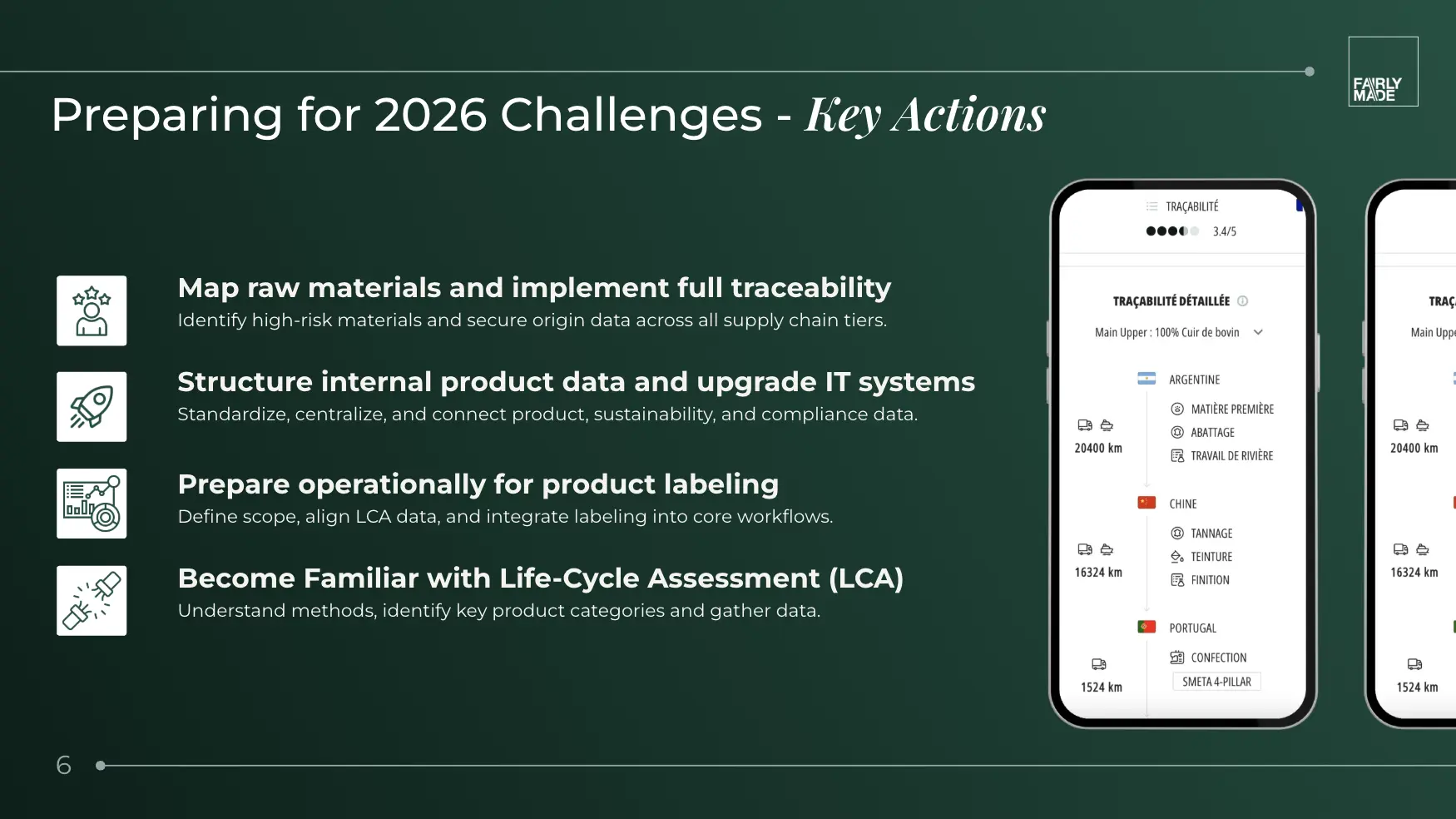
3. Prepare Operationally for Product Labeling
France's Climate & Resilience Law with Environmental Cost encourages brands to display environmental impact labels, and similar labeling requirements are emerging across the EU. Operational readiness involves more than compliance, since it affects design, packaging, and marketing workflows.
To prepare:
- Define a clear labeling scope, including which product categories are covered, where the information will be displayed (online, in store, or on product tags), and how labels will be produced and printed.
- Standardize LCA methodologies and data ownership to ensure scores are consistent, reproducible, and aligned with approved calculation rules.
- Integrate labeling data into core IT systems so environmental information flows automatically from product data and LCA tools to consumer-facing channels.
Embedding labeling into operational processes means avoiding last-minute adjustments and reinforcing consumer trust.
4. Become Familiar with Life-Cycle Assessment (LCA) and Impact Measurement
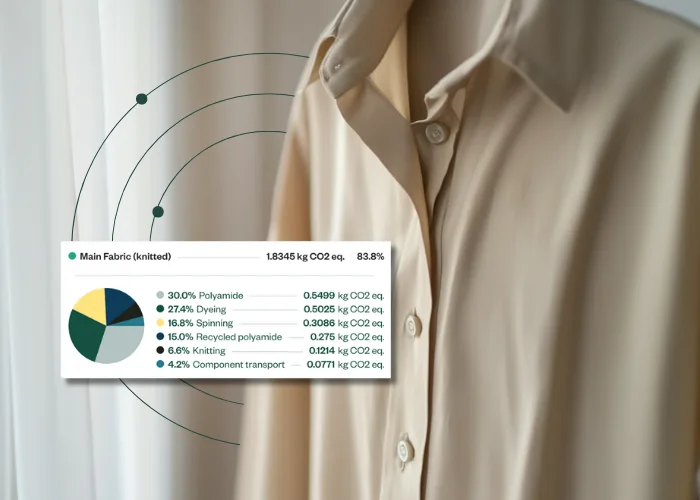
Understanding and reporting environmental impact is at the core of several 2026 regulations, such as Digital Product Passports and French Environmental Cost. Life-Cycle Assessment (LCA) allows brands to quantify environmental footprints from raw material sourcing to disposal.
Operational steps to get started:
- Identify key product categories and gather data on energy use, water consumption, greenhouse gas emissions, and waste.
- Use standardized LCA tools to calculate impact at product level.
- Integrate LCA results into internal dashboards, reporting platforms, and eventually, consumer-facing labels.
Brands that master LCA early will not only meet regulatory obligations but can use these insights to drive product innovation, material substitution, and sustainable design.
5. Start Early to Turn Compliance into Competitive Advantage
The key to operational readiness in 2026 is proactive preparation. Waiting until regulations are enforced will result in rushed processes, higher costs, and potential market delays. Early action allows brands to:
- Strengthen supply chain resilience through full traceability.
- Build structured product data systems that integrate sustainability metrics.
- Embed labeling, LCA, and reporting processes into daily operations.
- Train teams to operate confidently under new regulatory expectations.
Brands that treat compliance as an operational priority will not only avoid penalties but also strengthen brand reputation and consumer trust in a market increasingly driven by transparency and sustainability.

.svg)


