

Supply Chain Traceability: How It Saves Money and Resources


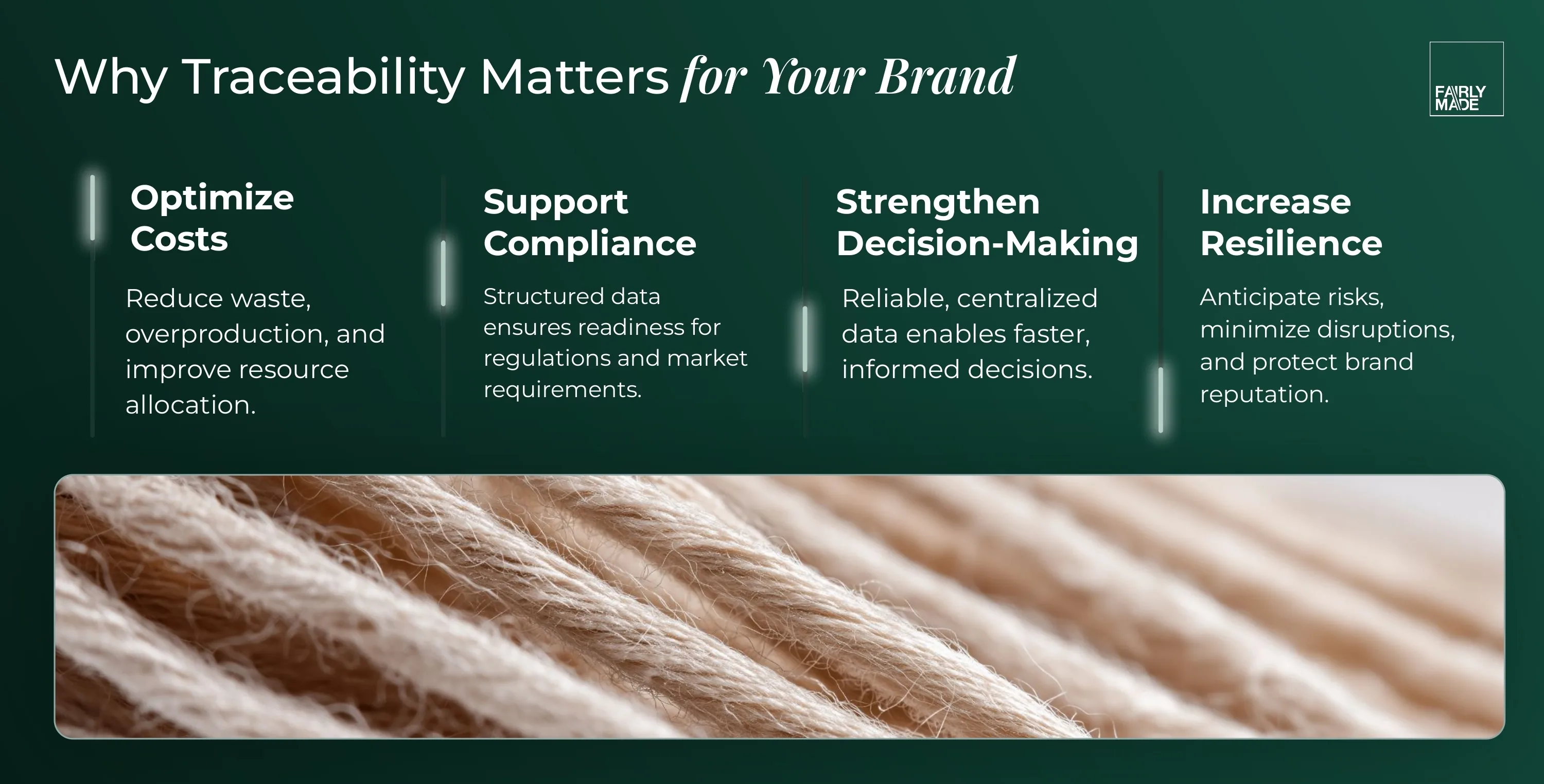
For many brands, supply chain traceability is still perceived as a compliance requirement or a sustainability initiative. In practice, it is a core driver of operational efficiency and cost performance.
By providing clear visibility over suppliers, materials, and production flows, traceability enables companies to identify inefficiencies, reduce waste, and make faster, more informed decisions. Organizations that structure and centralize their supply chain data move from fragmented processes to a model built on control, accuracy, and scalability, with measurable financial impact.
1. Operational Efficiency: From Fragmentation to Control
One of the most immediate benefits of traceability is improved operational efficiency. Many brands still rely on fragmented systems such as spreadsheets, emails, and multiple software tools to manage supply chain data. This leads to duplication, errors, and time loss.
A centralized traceability approach fundamentally changes this dynamic.
Key efficiency drivers:
- Centralized data collection: eliminates repetitive manual inputs and reconciliation work
- Cross-team alignment: procurement, compliance, and product teams rely on the same dataset
- Error reduction: fewer tools and integrations reduce inconsistencies
- Faster execution: streamlined workflows accelerate reporting and decision-making
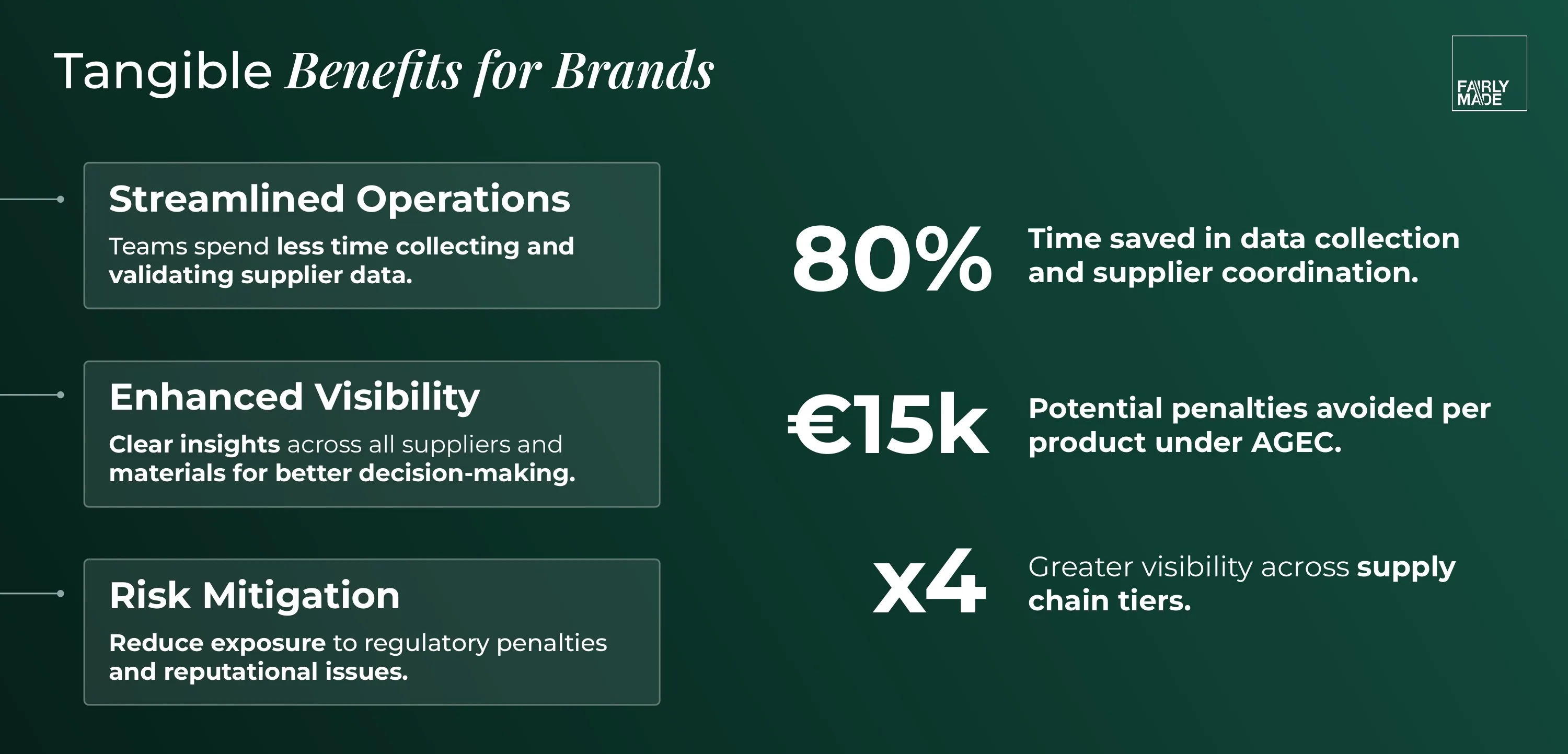
Based on the experience of brands that work with us, adopting a centralized traceability model can deliver up to 80% time saved through a one-stop-shop approach with dedicated traceability support. This represents thousands of hours recovered annually, allowing teams to focus on higher-value tasks instead of manual data handling
2. The Hidden Cost of Multi-Tool Ecosystems
A common inefficiency in supply chain management is the accumulation of specialized tools. These may include compliance platforms, mapping tools, and lifecycle analysis software.
While each tool serves a purpose, the overall system creates significant hidden costs:
- Multiple SaaS subscriptions
- Integration and maintenance costs
- Repeated onboarding and training efforts
- Data inconsistencies across systems
Brands we work with often avoid:
- 2 to 3 separate tool subscriptions
- Integration costs ranging from €30K to €50K
Reducing these costs directly improves operational efficiency and reduces unnecessary complexity.
3. Extended Traceability: A Lever for Direct Gains
Extending traceability beyond Tier 1 suppliers unlocks additional financial benefits. At this level, traceability becomes a tool for cost optimization and margin improvement.
3.1 Customs Duty Optimization
By tracing raw materials back to their origin, brands can prove preferential origin and leverage Free Trade Agreements with several countries.
This enables:
- Reduced or eliminated customs duties
- Improved margins on international trade
3.2 Regulatory Risk Mitigation
Traceability is increasingly linked to regulatory compliance. Limited visibility exposes brands to financial penalties and operational disruption.
For example:
- France's Anti- waste and Circular Economy Law (AGEC): from €15,000 per non-compliant product
Under the Uyghur Forced Labor Prevention Act, the risks extend further and directly affect market access.
Key risks of non-compliance include:
- Reputational risk: exposure from media, NGOs, and political stakeholders
- Financial risk: civil penalties under U.S. customs law
- Corrective actions: detention, exclusion, or seizure of goods, import bans, and potential loss of access to the U.S. market
Traceability acts as a financial safeguard, helping brands avoid both direct penalties and revenue loss linked to blocked shipments or restricted market access.
3.3 Supplier Visibility
A key benefit of traceability is enhanced supplier visibility. For instance, brands that work with us typically know four times more suppliers on average, which provides critical insight into their extended supply chain.
This deeper visibility enables:
- Early identification of potential compliance or sourcing risks
- Better monitoring of supplier practices and performance
- Proactive risk management to avoid penalties and reputational issues
Knowing more suppliers allows brands to act before problems escalate, supporting robust risk mitigation and operational resilience.
4. Decision-Making and Organizational Alignment
Traceability improves decision-making across teams by providing consistent and reliable data.
With end-to-end visibility:
- Teams operate from a single source of truth
- Decisions are faster and more accurate
- Cross-functional collaboration improves significantly
Time savings achieved earlier in the process also compound here. When teams no longer spend hours collecting or validating data, they can act faster and reduce delays across production and sourcing cycles.
This reduces costly errors such as:
- Incorrect sourcing strategies
- Misaligned production volumes
- Compliance gaps
5. Scalability Without Cost Inflation
As brands grow, operational complexity increases. Without structured traceability, this often leads to rising costs driven by new tools and manual processes.
Traceability provides a scalable framework:
- New suppliers can be integrated without heavy operational effort
- Data consistency is maintained across regions and product lines
- Compliance requirements can be addressed without redesigning systems
6. Strategic and Financial Risk Control
Traceability also strengthens long-term financial resilience by reducing exposure to operational and regulatory risks.
Key strategic benefits:
- Reputational protection: early identification of supply chain risks reduces exposure
- Regulatory anticipation: proactive compliance avoids penalties and disruption
- Investor confidence: transparent operations support ESG reporting
Avoiding penalties such as €15,000 per product under the AGEC law or potential market exclusion under UFLPA has a direct and measurable impact on financial performance.
Traceability as a Financial Infrastructure
Supply chain traceability is not only a transparency tool. It is a financial infrastructure that directly impacts cost, efficiency, and risk management.
By centralizing data and improving visibility, brands can:
- Save up to 80% of time spent on data collection and coordination (experience from brands that work with us)
- Gain 4 times greater visibility across their supply chain
- Avoid €30K to €50K integration costs
- Reduce exposure to €15K per product penalties under AGEC
- Mitigate UFLPA-related risks, including loss of market access
- Unlock customs duty savings and improve margins
- Reduce waste and optimize resource allocation
Traceability enables companies to operate with greater precision, lower risk, and stronger cost control. It is a practical and measurable lever for improving both operational performance and profitability.



.svg)


