
Digital Product Passport for Fashion: What It Is and How to Prepare (2026 Guide)


The Digital Product Passport (DPP) is moving fast from policy concept to technical reality, and for fashion brands it is no longer a distant idea.
Introduced under the EU's Ecodesign for Sustainable Products Regulation (ESPR), the DPP turns sustainability from a marketing claim into a structured, standardized, and auditable legal requirement.
In May 2026, we finally learned what it will contain: 49 data points every textile product will need to carry.
This guide breaks down what the Digital Product Passport is, what data it requires, the 2026–2030 timeline, and how your brand can prepare now, while early movers still hold an advantage.
Key takeaways
- The Digital Product Passport (DPP) is a mandatory digital identity for products sold in the EU, accessible by scanning a QR code, NFC tag, or RFID chip.
- In May 2026, the Joint Research Centre (JRC) published the first complete specification of DPP content for textiles: 49 data points across 4 categories.
- The minimum data granularity is the production batch, not the individual item. Item-level tracking stays voluntary.
- The binding rules come with the textile delegated act, expected end of 2027, with the first obligations landing on Spring/Summer 2028 collections.
- Preparation takes years of data work. Brands that structure their supply-chain data now turn compliance into a competitive advantage.
What Is the Digital Product Passport?
The Digital Product Passport is a mandatory digital identity for products placed on the EU market. It is introduced under the ESPR, a framework regulation designed to make products more durable, repairable, recyclable, and transparent.
Textiles and apparel have been identified as a priority sector.
In practical terms, the DPP requires each product to carry structured, standardized data covering its entire lifecycle. This information is accessible via a digital carrier (a QR code, NFC tag, or RFID chip) attached to the product, its packaging, or its documentation.
It must be readable at the point of sale, online and in-store, and remain available throughout the product's life, including resale and end-of-life stages.
At its core, the DPP creates a single digital identity for every product. But behind that simplicity lies a profound shift: sustainability is no longer narrative-driven. It becomes structured, standardized, and auditable.
The DPP Is a Dual System: Data and Infrastructure
To understand what is being built, it helps to see the DPP as two distinct but interconnected layers. The European Commission is working on both in parallel.
The data layer (the "what") is the content: everything that describes the product across its lifecycle, materials and production conditions, supply-chain traceability, environmental performance and circularity metrics (durability, repairability, recyclability), regulatory compliance documentation, and product documentation.
This layer is defined by the delegated acts, grounded in the technical work of the Joint Research Centre (JRC).
The system layer (the "how") is the technical backbone: the data carrier (QR / NFC / RFID), long-term data storage and accessibility, interoperability protocols, access-rights management and authentication, and the API connection to the EU registry.
This layer is defined by the 8 technical standards that set how the data is structured, transmitted, stored, and verified.
Without strong infrastructure, sustainability data cannot become regulation-compliant DPP data. The two layers only work together.
Understanding the ESPR: Why It Changes Everything
The ESPR is a framework law. It sets objectives and principles, while the specific technical requirements are defined through delegated acts for each product category.
Textiles and clothing are among the first sectors targeted in the European Commission's 2025–2030 ESPR working plan.
The delegated acts will determine which products are affected, the eco-design requirements by category, the exact format and data structure of the Digital Product Passport, and the required granularity (model, batch, or item level).
A delegated act cannot apply earlier than 18 months after entering into force, but that is not a reason to wait: once published, the window to comply is short, and the internal transformation required is significant.
The JRC Roadmap: From Milestones to 49 Data Points
The Joint Research Centre (JRC) develops the technical groundwork for the textile DPP through successive milestones, each adding a layer of detail that feeds the future textile delegated act.
Three milestones have already been released, and Milestone 3 is the most significant to date: it is where abstract policy objectives start becoming concrete, measurable product requirements. A fourth and final milestone is expected.
Milestone 3 turned policy goals into measurable criteria:
- Durability: a robustness score based on lab tests, with no minimum threshold at first.
- Recyclability: a score favoring mono-material and uncoated products.
- Recycled content: the only indicator with a proposed performance requirement, with minimum thresholds varying by product type (for example, 20% recycled cotton for denim).
- Environmental footprint: limited to the manufacturing phase, benchmark-based, using an existing EU PEF methodology.
- Substances of concern: mandatory disclosure aligned with existing REACH and POP regulations.
- Repairability: voluntary disclosure of repair services, not retained as a mandatory requirement.
One area, microfiber fragmentation, was assessed but excluded for now, due to the lack of mature and harmonized test standards.
The implication is immediate: what is measured defines what brands will optimize. A key debate continues over the limited consideration of raw materials in footprint calculations, which matters enormously for fashion, where fiber choice is often the single largest driver of a product's impact.
What the Passport Must Carry: the 49 Data Points
On 13 May 2026, the JRC published a Science for Policy report: the first complete specification of DPP content for textile apparel under the ESPR.
For the first time, the framework moved from an abstract promise to an operational checklist: 49 data points organized into four categories.
- Product identification: GTIN, model and batch IDs, HS / TARIC customs codes, and the ESPR & PEFCR product categories.
- Producer identification: manufacturer, importer, and facility IDs (GLN / EORI), with names, addresses, and contacts.
- Product information: fibre composition, robustness and recyclability scores, recycled content and its type of recycling, substances of concern (name, concentration), carbon and environmental footprint, care and warranty.
- Compliance documentation: a conformity certificate, or a self-declaration plus calculation parameters for verification.
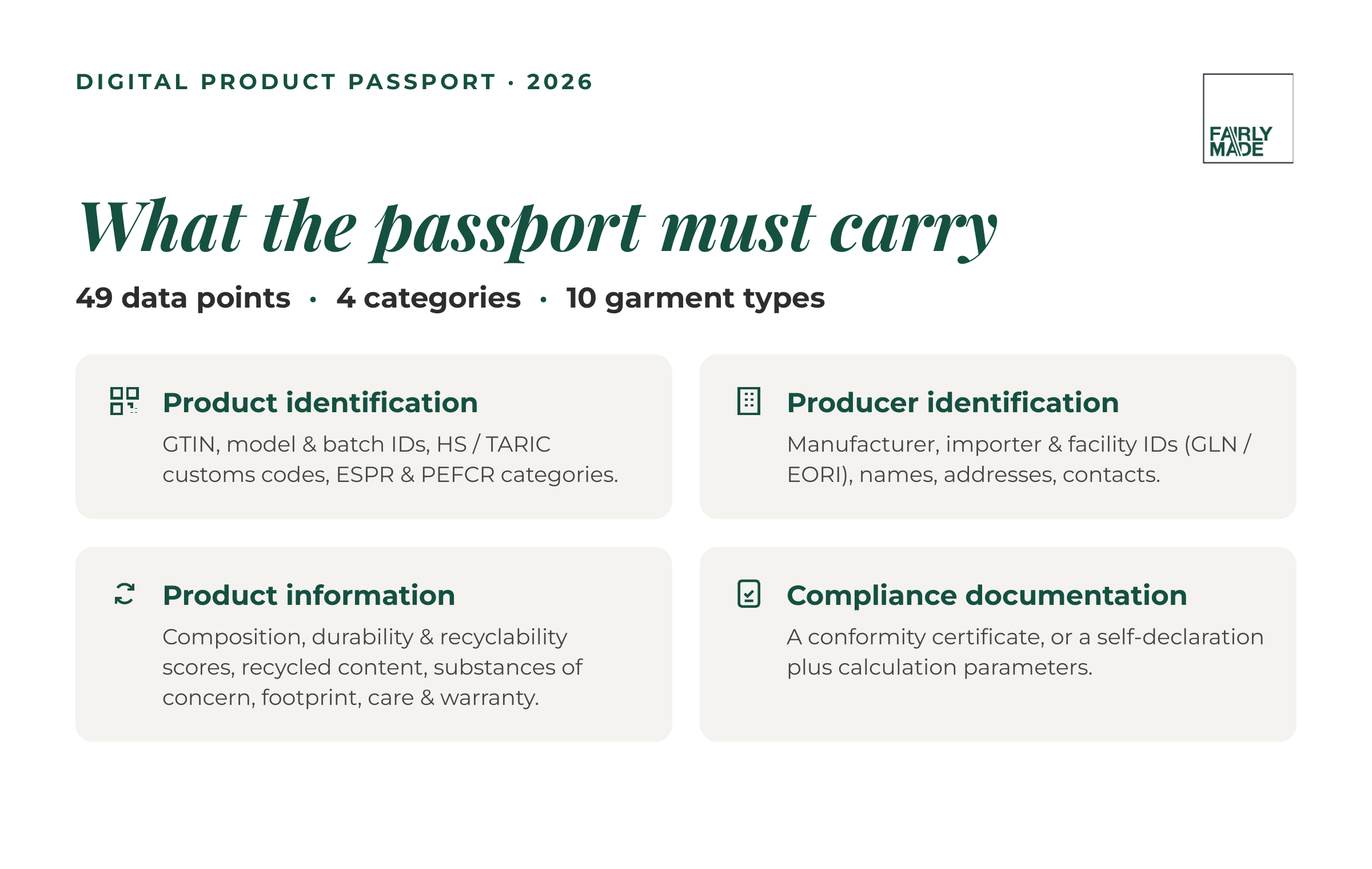
Scope: the specification covers 10 apparel categories taken from the PEF categories (t-shirts, shirts, sweaters, jackets, pants, dresses, leggings & socks, underwear, swimwear, and textile accessories). Workwear and sportswear are included.
Excluded are smart and e-textiles, PPE, medical devices, toys, and intermediate products (yarns, fabrics, fibres). The manufacturer (or the importer, when the manufacturer sits outside the EU) owns the passport.
This is not the final regulation, the binding requirements will be set by the textile delegated act, but it is the clearest preview yet of what brands will actually need to report.
A public consultation runs until 26 June 2026, the last major window for brands and industry to influence the data points before the Commission moves to drafting.
Inside the Spec: Granularity, Access, and Proof
Three design decisions in the specification will shape how brands build their data.
Batch becomes the baseline. The minimum granularity is the production batch, not the model alone. The batch ID becomes mandatory; producer, facility, and substances-of-concern data sit at batch level, while most product characteristics stay at model level. Item-level identifiers remain voluntary, which is good news for brands worried about tracking every individual garment.
Access is tiered. Data is split across three levels: public (identifiers, composition, durability and recyclability scores, recycled content, substances of concern by name and concentration, footprint performance class); authorities only (operator contacts, conformity documents, footprint calculation parameters); and legitimate interest (substance locations, end-of-life data, absolute footprint values).
The absolute footprint stays private, and only its performance class is public, a deliberate compromise between consumer transparency and protecting commercially sensitive information.
Two ways to prove compliance. Under Scenario A, the brand self-declares but backs it with third-party certification, and the passport carries only the certificate. Under Scenario B, the brand self-declares and provides the calculation parameters and technical file, kept under restricted access for authorities to recheck.
The choice has a large impact on workflow and cost.
The 8 Technical Standards: How the DPP Actually Works
In parallel with the content, the CEN/CENELEC Joint Technical Committee (JTC) 24 is delivering 8 harmonized standards under Mandate M/604.
These standards are the technical rulebook for how Digital Product Passports work, structured into four areas: identity and physical connection (unique product identifier, QR / RFID / NFC carriers), communication and APIs (standard APIs and exchange formats), architecture and data continuity (long-term storage and cross-sector interoperability), and a security and trust layer (role-based access rights, digital authentication and integrity).
All eight standards are now published. CEN and CENELEC released the first package of six on 27 May 2026 and the second package of two — EN 18239 (access rights and security) and EN 18246 (data authentication and integrity) — on 16 September 2026. Six were cited in the EU Official Journal on 15 July 2026, which means a passport built to them is presumed to conform with the ESPR.
The DPP Timeline for Fashion: 2026 to 2030
The framework is being built now, not in 2027. The key dates to plan around:
- May 2026: the first 6 DPP technical standards were published (IT architecture).
- May 2026: the JRC published the first complete DPP content specification (the 49 data points).
- June 2026: the public consultation on DPP content closed (last window to influence the rules).
- September 2026: the final 2 technical standards published.
- End of 2027: the textile delegated act is expected, defining mandatory DPP content in law.
- End of 2028 to mid-2029: the DPP becomes mandatory for priority sectors, including textiles. The first impacted collection is Spring/Summer 2028.
- 2030: the DPP scope is expected to extend to all products (footwear, leather goods, and beyond).
.webp)
Once the delegated acts are published, member states have up to 18 months to transpose them into national law. In practice, brands should count on operational systems being required by the end of 2028 at the latest.
Who Is Concerned?
All economic operators placing products on the EU market are affected: manufacturers, brands, importers, distributors, retailers, component suppliers, and digital platform providers. For fashion brands, this means the DPP is not solely a CSR responsibility.
Manufacturers must ensure compliance before market placement. Importers and distributors must verify it. Retailers must ensure product information is visible to consumers. Suppliers must provide traceable and reliable data. And DPP platform operators must guarantee hosting, accessibility, interoperability, and data integrity for at least ten years.
This is a cross-functional transformation project.
Why CSR and IT Must Align Now
The Digital Product Passport is fundamentally a data-governance challenge.
CSR teams define sustainability metrics, validate methodologies, calculate environmental footprints, and ensure regulatory alignment. IT teams structure, store, connect, and secure that data across systems: PLM, ERP, LCA tools, supplier portals, and traceability platforms.
The DPP requires interoperable systems, secure and durable data hosting, role-based access for stakeholders, integrity safeguards, and seamless data flow across the value chain. Without that foundation, sustainability data never becomes compliant DPP data.
Sanctions and Risks of Non-Compliance
Member States will enforce the ESPR with administrative fines that must be effective, proportionate, and dissuasive. Non-compliant products can be withdrawn from the market, and fraud, data tampering, or intentional omission may lead to increased penalties.
Beyond financial sanctions, the reputational risk is significant, and non-compliance can mean exclusion from public procurement. For brands operating in the EU, this is both a compliance issue and a business-continuity issue.
From Greenwashing to Verified Transparency
The Digital Product Passport resolves the greenwashing-versus-greenhushing dilemma.
Under the DPP, sustainability claims become structured, standardized, and verifiable. Transparency is embedded in the product itself, and communication shifts from storytelling to regulated disclosure.
Consumers gain reliable data, regulators gain oversight, and brands gain a framework for credible communication. Trust becomes measurable.
Why Acting Now Creates a Competitive Advantage
Although enforcement for textiles lands between 2028 and 2030, preparation requires years of internal restructuring. The regulation is being grounded in existing industry capabilities, which means current data practices will shape future obligations, and brands that engage now are influencing how demanding the rules become.
Brands that start now can improve data quality and traceability, optimize product design around durability and recyclability, anticipate recycled-content thresholds, and align supply chains before regulatory pressure intensifies.
Those who wait risk rushed implementation, higher costs, and operational disruption.
How Fairly Made Helps You Prepare for the DPP
Preparing for the Digital Product Passport starts long before the delegated acts are published, and it rests on one foundation: reliable, structured, and centralized product data across the value chain. This is exactly what Fairly Made is built for.
Fairly Made is a leader in traceability and impact for fashion in France and Europe, with 100+ brands across 15 countries, 30,000+ factories connected, and 100,000+ life-cycle assessments (LCAs) run on the platform.
That scale matters for the DPP because the passport's hardest data points, environmental footprint, substances of concern, and recycled content, are precisely the ones the industry is least ready for.
Here is how that translates into DPP readiness:
- Traceability is the DPP foundation. Fairly Made structures supply-chain data at product and batch level, exactly the granularity the DPP requires, so there is no scramble to re-collect data when the delegated act lands.
- Impact data, already calculated. Traceability data feeds an embedded, real-time LCA engine, so carbon and environmental footprints are computed in line with European methodologies, no more multi-week manual processes.
- Real, measured ROI. Brands identify up to 12x more suppliers and CSR teams save up to 75% of their time on data collection. The platform is typically operational in around 8 weeks.
Beyond the platform, Fairly Made actively contributes to European discussions on environmental labeling and DPP implementation. By centralizing traceability and impact measurement today, brands cut future compliance risk and implementation cost, and turn fragmented sustainability efforts into standardized, audit-ready, regulation-aligned product information.
In short, Fairly Made helps fashion brands move from sustainability ambition to a structured, future-proof data foundation, ready for the Digital Product Passport before it becomes mandatory.
To go deeper, download our DPP Playbook or book a demo.
Comply with the latest regulations




%20for%20Apparel%20-%20The%20Ultimate%202025-2026%20Guide.webp)




.webp)



.webp)





.svg)


