

PO & TC Management: Why Purchase Order Traceability Is the New Standard for Fashion

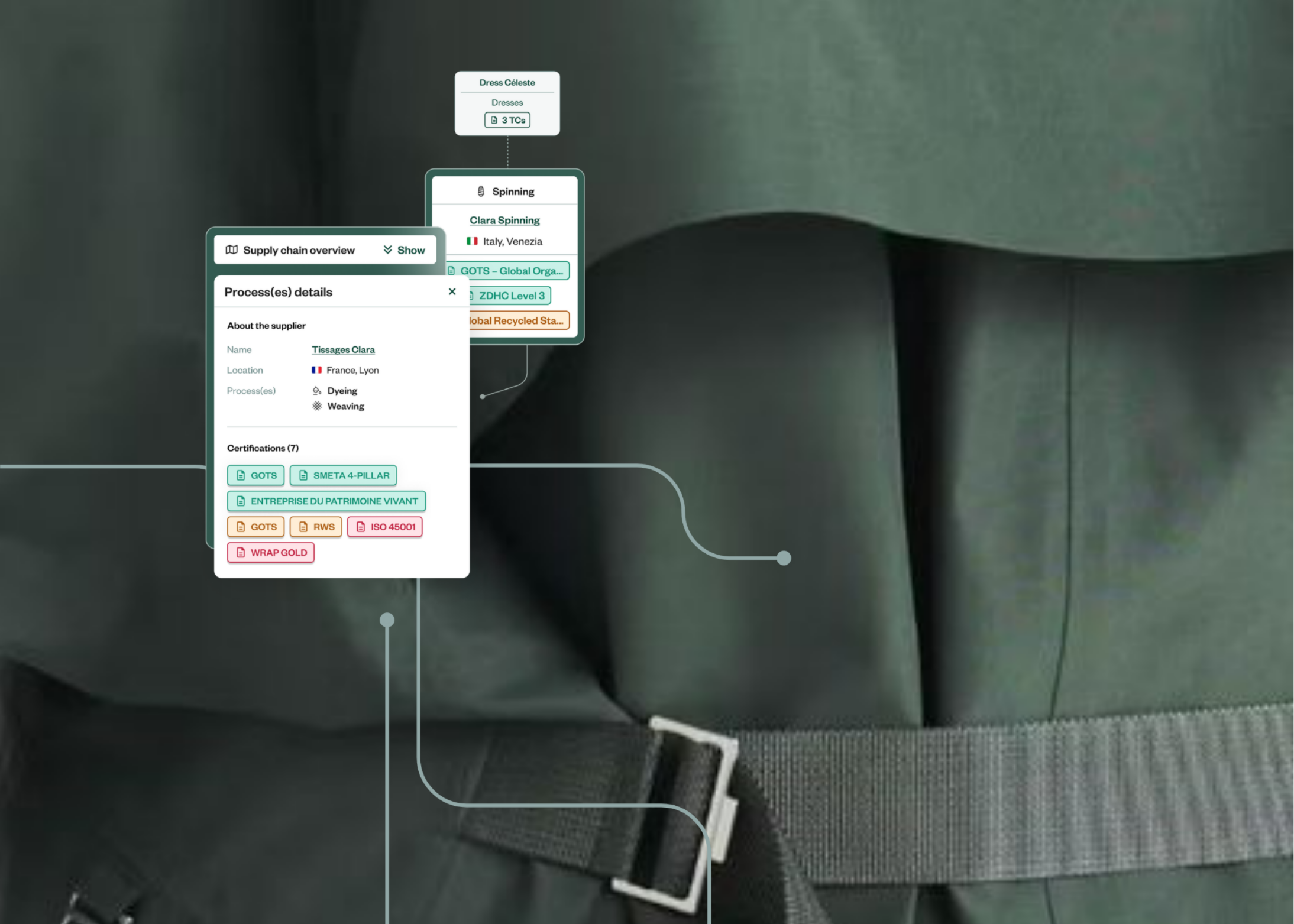
Supply chain traceability in fashion is becoming more granular. As regulatory expectations rise and sustainability claims face closer scrutiny, brands are increasingly asked not only where a product comes from, but how each specific order was produced. Traceability built on averaged product models struggles to answer that question with confidence. PO & TC management, the structured collection of purchase order (PO) traceability data and transaction certificates (TCs), addresses this directly. It replaces generalized estimates with verifiable, order-by-order proof of how and where each production took place. This article sets out what PO & TC management involves, why it now matters, and how Fairly Made makes the process faster rather than more burdensome.
What "PO & TC Management" Actually Means
Two terms sit at the heart of credible supply chain transparency. PO & TC management is the practice of collecting, validating, and displaying both systematically, rather than retrieving them by email after production has finished.
What Is a Purchase Order (PO)?
A PO (Purchase Order), also called an order form or ordre de fabrication, is the record of a specific order placed with a supplier. It is the unit that makes order-level traceability possible.
What Is a Transaction Certificate (TC)?
A TC (Transaction Certificate) is a document that proves the object of a transaction between two suppliers is genuinely certified. When a spinning mill buys GOTS-certified organic cotton, it receives a TC. When it sells the resulting yarn to a weaving factory, it issues a new one. Each link in the chain is documented, so the entire supply chain can be verified, from raw cotton to finished garment.
Why PO-Level Traceability Beats Reference-Level Traceability
Reference-Level Traceability: A Useful but Limited Average
Most brands begin with reference-level traceability, tracking information for a product model such as a "Basic 100% Organic Cotton T-shirt." This provides a useful average view of materials, suppliers, and countries, which is appropriate for product pages and broad impact analysis. It also carries a structural limitation. When the same style is produced across several factories or countries, the data is generalized. A reference recorded as "Made in Bangladesh" may include batches actually produced in Turkey.
PO-Level Traceability: Proof for Every Order
PO-level traceability resolves this. It tracks information for each actual production, meaning each supplier order. The January order made in Turkey with Turkish cotton and the March order made in India with Indian cotton are captured as the distinct realities they are. This fine-grained, verifiable traceability is what auditors and regulators increasingly expect.
What Regulators Now Expect
That precision is no longer optional. Frameworks such as the EU Corporate Sustainability Due Diligence Directive (CSDDD), the Corporate Sustainability Reporting Directive (CSRD), and the OECD Due Diligence Guidance for the Garment and Footwear Sector all direct brands toward order-level proof of origin. Reporting on Scope 3 emissions, country-of-origin accuracy, and mechanisms such as CBAM becomes considerably simpler when traceability data is anchored to real purchase orders rather than to an averaged model.
Transaction Certificates: Proof That "Certified" Really Means Certified
What a Transaction Certificate Proves
A certified material is only as trustworthy as the documentation behind it. Transaction certificates provide that assurance. In practical terms, a TC proves that the certified material a supplier claims to sell is the certified material they actually received, and that it has not been mixed with non-certified stock along the way.
How the Chain of Custody Works
This is essential because certification bodies such as GOTS and Textile Exchange, which governs standards including the GRS, depend on an unbroken chain of custody. A TC lists batch details, quantities, and the certificate of the original supplier, allowing each transaction to be checked and traced. Without organized TC collection, a brand investing in certified, and therefore higher-cost, materials has no reliable way to demonstrate that the premium is justified.
The Hidden Cost of PO & TC Management: Time
Handled manually, TC and PO data collection is slow and resource-intensive. Brands chase suppliers and certification bodies by email, reconcile conflicting responses, and re-enter information into spreadsheets. In our experience across brand projects, collecting transaction certificates can account for up to 25% of a CSR team’s time.
In short, building the data that makes a brand credible can be demanding on teams. Centralizing collection on a dedicated platform, where suppliers are prompted to upload their certificates directly, reduces manual follow-ups and helps make traceability a source of efficiency rather than a cost.
How Fairly Made Saves Time on PO & TC Management
Fairly Made now includes dedicated features for purchase order traceability and transaction certificate management, designed to save time for brands and suppliers alike.
Automatic Transaction Certificate Collection
When a supplier declares an item as certified, the platform automatically prompts them to upload the matching certificate. There is no separate document chase. TCs appear in the app as soon as they are uploaded, ready for clients to preview and download.
A Real-Time Traceability Tree
Brands gain a real-time traceability tree that updates as suppliers submit data, allowing them to switch components, preview TCs, and trace at PO level through an interactive map. The result is a shift from reactive document-chasing to a system in which credible, order-level data flows in continuously.
For brands ready to go further, this same order-level data becomes the foundation for due diligence and supply chain intelligence, where traceability is turned into active risk management.

Reducing Supplier Fatigue: Our Number One Focus
Saving time for brands only works if it doesn't shift the burden onto suppliers. That is why reducing supplier fatigue is our top priority. With our catalog feature for example, any data a supplier has already entered becomes reusable: declare an item once, and it can be reused to validate a new request automatically, without re-entering the same information.
The result is a system where moving from reference-level to PO-level traceability adds precision without multiplying the workload. And this is only the beginning, our goal is to make every supplier declaration a reusable asset, so that credible, order-level data becomes faster to produce with each cycle.
Traceability That Pays for Itself
PO & TC management is not an administrative burden reserved for the most mature brands: it is becoming the baseline for any company making sustainability claims. PO-level traceability delivers the verifiable precision that regulators and auditors require, while organized transaction certificate management protects the integrity of certified materials. With Fairly Made, that precision arrives without the manual workload that once made it so costly.
In a competitive market, supply chain transparency is no longer optional. Implemented well, it becomes a strategic advantage that saves time, builds trust, and protects the bottom line.



.svg)


